
The Massachusetts Starter Homes Ballot Question is part of a broader shift in how housing is being discussed across the state, especially as homeowners look for more flexible ways to expand their living space through ADUs, home additions, and multigenerational design.
Across Massachusetts, homeowners are asking a more practical question: How can I make my current home work better for my family’s future?
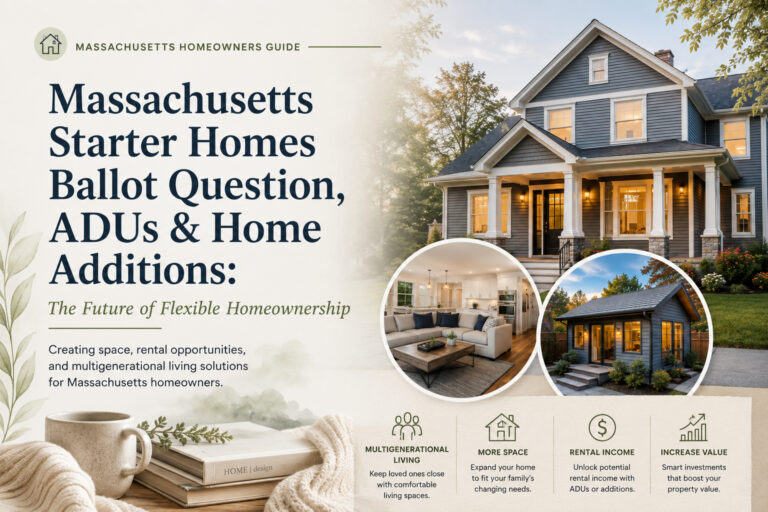
The Massachusetts Starter Homes Ballot Question is a proposed zoning initiative that would allow smaller single-family homes to be built more easily on qualifying residential lots. While it may increase housing supply modestly, it is only one part of a larger statewide effort to improve housing flexibility alongside ADUs and home additions.
The Massachusetts Starter Homes Ballot Question highlights a growing conversation about housing availability, affordability, and flexibility across the state.
But for most homeowners, the real impact of this conversation is not about policy — it is about possibility.
Families across Massachusetts are dealing with:
Instead of moving, many homeowners are now exploring how to adapt their existing home through:
The biggest opportunity is not only building new homes — it is reimagining the homes people already own.
Across Eastern Massachusetts, including Norfolk County, Plymouth County, and Greater Boston suburbs such as Stoughton, Milton, Canton, and Westwood — homeowners are experiencing similar challenges.
These include:
This has led to a major shift:
Homeownership is no longer just about buying or selling — it is about adapting.
The Massachusetts Starter Homes Ballot Question is a proposed zoning reform designed to increase opportunities for smaller single-family homes in residential areas.
The goal is to expand housing access by allowing more flexible development on qualifying lots where infrastructure already exists.
This includes concepts such as:
While this proposal may increase housing supply modestly, it does not fully address Massachusetts’ broader housing challenges.
Instead, it represents a shift toward more flexible housing models.
Research suggests that while the Starter Homes proposal may add housing supply, it is not enough to solve the statewide shortage on its own.
That is why homeowners are increasingly focused on solutions that are already within their control.
The most immediate opportunities often include:
The future of housing is not only new construction.
It is home transformation.
An accessory dwelling unit (ADU) is a secondary residential living space located on the same property as a primary home.
ADUs can take several forms, including:
ADUs are becoming one of the most flexible housing solutions in Massachusetts because they can serve multiple purposes:
Family Housing Opportunities
Accessory dwelling units allow homeowners to unlock unused potential in their property without leaving their community.
A home addition in Massachusetts allows homeowners to increase living space while remaining in the home and neighborhood they already love.
Home additions are especially valuable for families who:
A well-planned addition can completely change how a home functions without requiring relocation.
Multigenerational living in Massachusetts is becoming increasingly common as families look for ways to live together while maintaining privacy and independence.
This approach often includes:
The goal is simple:
Keep families close while giving each generation independence.
Yes, in many cases, additional living space can create rental opportunities depending on local zoning and regulations.
Homeowners may use added space for:
In a high-demand housing market like Massachusetts, flexible living space can significantly improve long-term property value and financial stability.
| Solution | Purpose | Best For |
|---|---|---|
| Starter Homes | Increase housing supply | First-time buyers |
| ADUs | Create flexible living space | Families, rental income, aging in place |
| Home Additions | Expand existing homes | Growing households |
The Massachusetts Starter Homes Ballot Question focuses on new housing supply.
But ADUs and home additions focus on something equally important:
Helping homeowners adapt the homes they already own.
Homeownership is no longer just about moving through life stages.
It is about designing a home that evolves with you.
Modern homes can now function as:
This shift is reshaping how homeowners approach renovation and expansion.
At Reliable Roofing, Siding & Windows, we help homeowners improve, expand, and protect their properties with long-term thinking in mind.
Whether you are considering:
We help homeowners understand what is possible before they begin building.
Because the best homes are not just built for today — they are built for what comes next.
It is a proposed zoning reform designed to increase opportunities for smaller homes in Massachusetts residential areas.
No, it is only one part of a broader housing strategy.
A secondary living space on the same property as a primary home.
Often yes, depending on local zoning regulations.
They can improve functionality, flexibility, and long-term property value.
An ADU is a separate living unit, while an addition expands the primary home.
The Massachusetts Starter Homes conversation is really about one thing: Creating more ways for people to live comfortably in the communities they love.
For many homeowners, that opportunity already exists within their current property.
If you are considering a home addition, ADU-style expansion, or long-term planning for your home, Reliable is here to help guide the process.